Last month, the CORE team authored an article on human rights due diligence and the EU Forced Labour Regulation (EUFLR). This month, we’re examining how human rights due diligence relates to the EU Regulation on Deforestation-Free Products, or in short, the EUDR.
Before we delve into the topic of this article, let’s provide a quick intro to the EUDR:
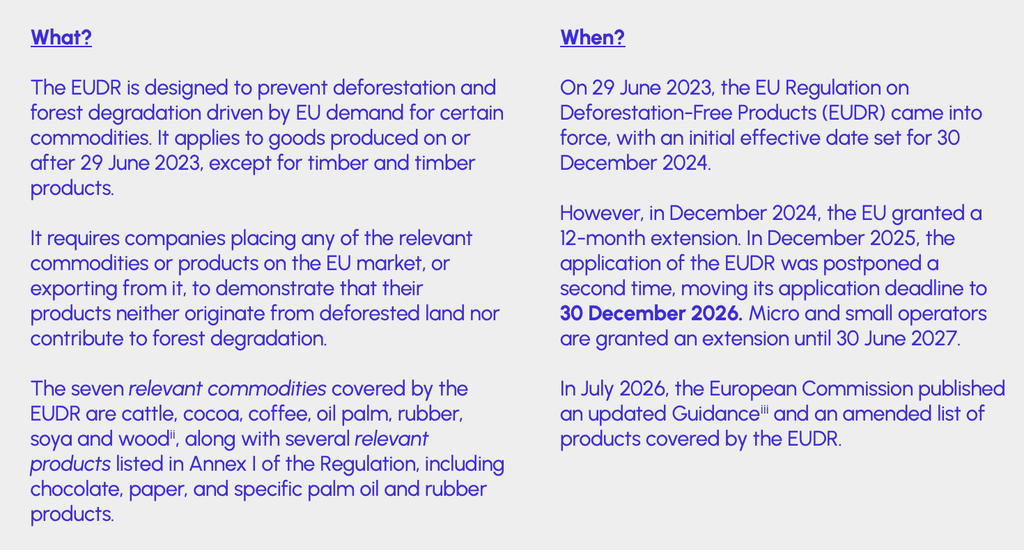
The EUDR is not a blanket prohibition. It allows companies to place or export relevant commodities and products on the EU market if certain conditions are met. It bans the placing or making available of relevant commodities and products in the EU market or their export unless all of the following conditions are met:
- Deforestation-free: Products must have been produced on land that has not been subject to deforestation (or forest degradation, for products containing or made from wood) after 31 December 2020.[i]
- Compliance with domestic legislation: Products must be produced in accordance with the relevant laws of the country of production, including legislation concerning land use rights, labor rights, environmental protection, forest-related regulations, human rights protected under international law, and the principle of free, prior, and informed consent (FPIC).[ii]
- Due diligence statement or simplified declaration: Operators must provide a due diligence statement (DDS) confirming due diligence was conducted, with no or only negligible risks of deforestation (i.e., no cause for concern). This statement must include all relevant information set out in Annex II of the EUDR and should be submitted to the competent authorities via the EUDR Information System (IS) before placing the relevant product on the EU market or exporting it.[iii]
To meet the above conditions and effectively implement the EUDR, companies must conduct due diligence. For operators subject to standard due diligence, this must entail:
Gathering relevant information:
This includes a description of the relevant commodities such as quantity, country of production, geolocation of land plots, date or time range of production, identification of the businesses or individuals supplying or receiving the products, and information confirming that the products are deforestation-free and produced in accordance with domestic laws.[iv]
Conducting a risk assessment:
Companies must assess the risk of non-compliance for each product, considering factors[v] such as the presence of Indigenous Peoples, the prevalence of deforestation or forest degradation, and the three-tier country risk classification (high risk, low risk or standard risk), established by the EU Commission.[vi]
Adopting risk mitigation measures:
These may include independent surveys or audits, requests for additional information, or collaboration with suppliers on capacity building and investments.[vii] Simplified due diligence is sufficient for operators sourcing exclusively from countries or regions classified as low risk based on the EU Commission’s classification, with no need for risk assessments or mitigation measures.[viii]
Reviewing the due diligence system:
Companies must review their due diligence system at least annually and on an ad-hoc basis. They must update it when they become aware of new developments that could influence the system.
Reporting annually:
Non-SME operators must publicly report on their due diligence every year, including on steps taken to implement EUDR obligations. Reporting under other EU due diligence legislation may fulfil this requirement[ix] if it includes the information necessary under the EUDR.
The due diligence obligation has its nuances, however:
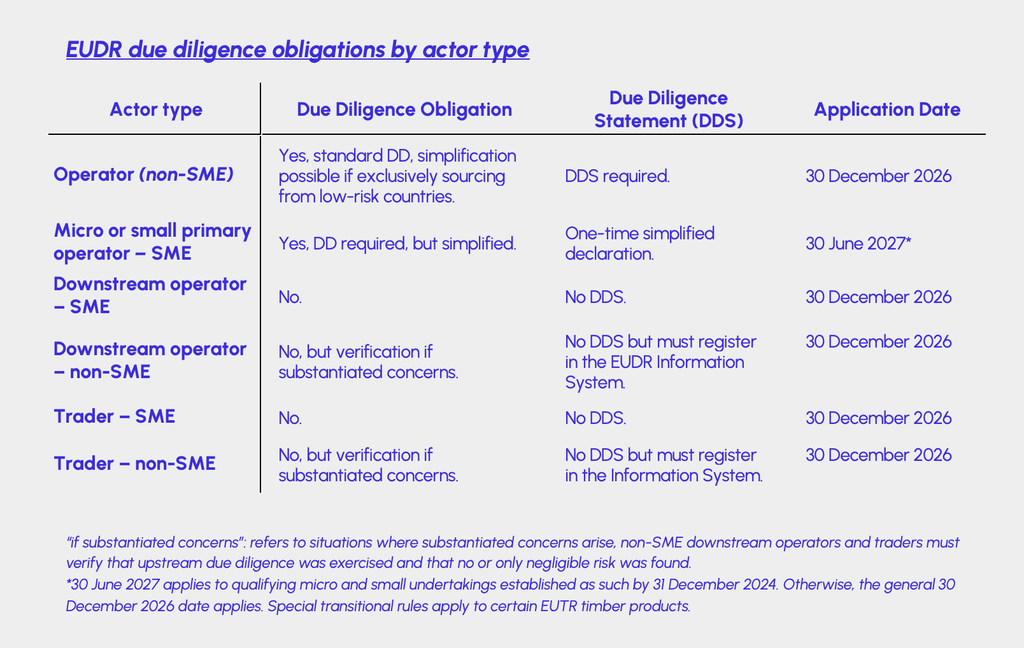
- Operator vs. downstream operator vs. trader: The EUDR distinguishes between operators, downstream operators and traders and a company can hold different roles for different products. This distinction matters in the context of due diligence obligations, with downstream operators and traders not being required to exercise due diligence but to lighter information collection obligations.[x] Non-SME downstream operators and traders must also register in the EUDR Information System. Where substantiated concerns arise, they must also be able to verify that upstream due diligence was exercised and that no or only negligible risk was found, making due diligence a sensible and proactive business decision.
- SME vs. non-SME: The EUDR also distinguishes between micro or small primary operators (SMEs) and larger operators. SME operators are subject to a specific simplified due diligence regime and need to submit a one-time simplified declaration instead of a DDS.
- Exclusive sourcing from low-risk countries: Operators of any size sourcing exclusively from low-risk countries or regions may also benefit from a simplified due diligence regime, if sourcing exclusively from countries or parts thereof classified as low risk.
Four Key Steps for EUDR-Aligned Due Diligence:
The following practical recommendations outline key actions that can help businesses prepare for the EUDR and navigate the complexities of maintaining deforestation-free supply chains.
1. Map your supply chain against the EUDR commodities and relevant products
The first step is to map your supply chain and identify the relevant commodities and products that fall under the scope of the EUDR, based on the tariff classification of the EU’s Combined Nomenclature.
2. Increase transparency and traceability of the commodity and/or product supply chain
A significant challenge for companies, especially downstream ones, is the lack of traceability in their supply chains to ensure relevant commodities are deforestation-free. Companies should explore available tools and data to assess risks at the scale of key sourcing areas or at production level. This also requires engaging with suppliers to improve traceability and establish a clear view of sourcing practices.
3. Assess your current business models and purchasing practices
Ensuring deforestation-free supply chains is a gradual process that may require a shift in business strategy. Companies must critically evaluate their current business models and procurement practices and address opaque supply chains that hinder traceability. Models of direct sourcing from cooperatives or smallholder farmers allow for greater supply chain traceability and more leverage over production conditions. Such sourcing approaches can also contribute to forest conservation, for example, by offering premium payments to producers and cooperatives that avoid deforestation.[30]
Ultimately, companies must assess whether their sourcing models and volume strategies for certain commodities or products contribute to deforestation and forest degradation. They should also evaluate the extent to which they can reduce this impact (e.g., by decreasing sourcing volumes of paper-based single use packaging and investing in innovative packing designs).
4. Evaluate the use and reliance on certifications.
As highlighted in our CORE message on certifications and audits, while audits and certifications can complement corporate due diligence efforts, they cannot replace a company’s obligation to conduct meaningful human rights and environmental due diligence. Companies should carefully assess when and how audits and certification schemes can be effective mechanisms to tackle the risk of deforestation.
To learn more about how CORE supports companies in building human rights due diligence systems aligned with various corporate sustainability laws and international business and human rights standards, get in touch at serra@peopleatcore.com.
Serra for the CORE team
[i] Art. 2 (13) of The Regulation 2023/1115 of the European Parliament and of the Council of 31 May 2023 (EUDR) on the making available on the Union market and the export from the Union of certain commodities and products associated with deforestation and forest degradation and repealing Regulation (EU) No 995/2010. Information about the July 2026 extension can be found on here: European Commission, Environment, Directorate-General for Environment.
[ii] Art. 2 (40) of the EUDR.
[iii] Art. 4 (2) of the EUDR.
[iv] Art. 9 of the EUDR.
[v] Art. 10 of the EUDR.
[vi] Art. 29 of the EUDR and the EUDR Country Classification List.
[vii] Art. 11 of the EUDR.
[viii] Art. 13 of the EUDR.
[ix] Art. 12(3) of the EUDR.
[x] Art. 5(3) of the EUDR.