One issue that has emerged in our discussions with companies in the context of the EU Forced Labour Regulation (EUFLR) has been the scope of the Regulation, particularly with respect to forced child labor – one of the worst forms of child labor. While many companies have established processes to identify and address child labor risks, forced child labor is often insufficiently considered. This is largely because distinguishing between child labor and forced child labor in practice can be challenging.
In this short blog post, the CORE team explores these two separate risks and offers recommendations on how to distinguish between them in practice. We encourage companies to adopt a holistic approach to addressing child labor and forced child labor risks that recognizes the continuum between different forms of child labor and enables more effective risk identification, assessment and mitigation.
What does the EUFLR say about forced child labor?
In short, the EUFLR prohibits placing or making available on the EU market products made with forced labor, as well as exporting such products from the EU. The Regulation will apply from 14 December 2027.
The EUFLR relies on ILO’s definition of forced labor (ILO Convention No.29), which defines it as any work or service exacted from a person under the threat of a penalty, and for which the person has not offered themselves voluntarily. The EUFLR explicitly includes forced child labor and forced labor imposed by state authorities.
Companies operating in global supply chains therefore face a clear obligation: to ensure that no products placed on the EU market, made available within it, or exported from it are produced using forced labor, including forced child labor.
At first glance, the scope appears precise and manageable. Forced labor is a well-defined legal concept, centered on coercion and lack of voluntariness.
Yet, in practice, companies rarely encounter such neatly bounded categories, particularly when it comes to forced child labor. Forced child labor often emerges from broader patterns of child labor that are more difficult to identify and assess.
Child labor v. forced child labor: Definitions and guidance in theory
According to the ILO, forced labor refers to work imposed on a person against their will through coercion. [1] Involuntary work alone is a necessary but insufficient condition for forced labor; it must be coupled with coercion.[2] Forced labor often involves subtle forms of coercion, including debt manipulation, isolation or restriction on freedom of movement.
In the context of forced child labor, the elements of involuntariness and coercion must be assessed using criteria that take into account the particular vulnerability of children. For instance, the menace of a penalty may be applied to a child’s parents rather than directly to the child and still constitute coercion.[4]
There is no agreed legal definition of forced child labor. Neither the ILO Forced Labour Convention (No. 29) nor other ILO legal standards explicitly define it.[5] However, guidance can be found in the International Conference of Labour Statisticians’ Guidelines Concerning the Measurement of Forced Labour[6], which explain that forced child labor includes work:
- performed under the threat of a penalty imposed by a third party on the child or their parent,
- performed where one or both parents are themselves in forced labor, or
- constituting one of the worst forms of child labor under ILO Convention No. 182, including slavery, such as the sale and trafficking of children, debt bondage and forced or compulsory labor. [7]
By contrast, child labor refers to work that deprives children of their childhood, potential and dignity, is harmful to their development, and/or interferes with their education.[8]
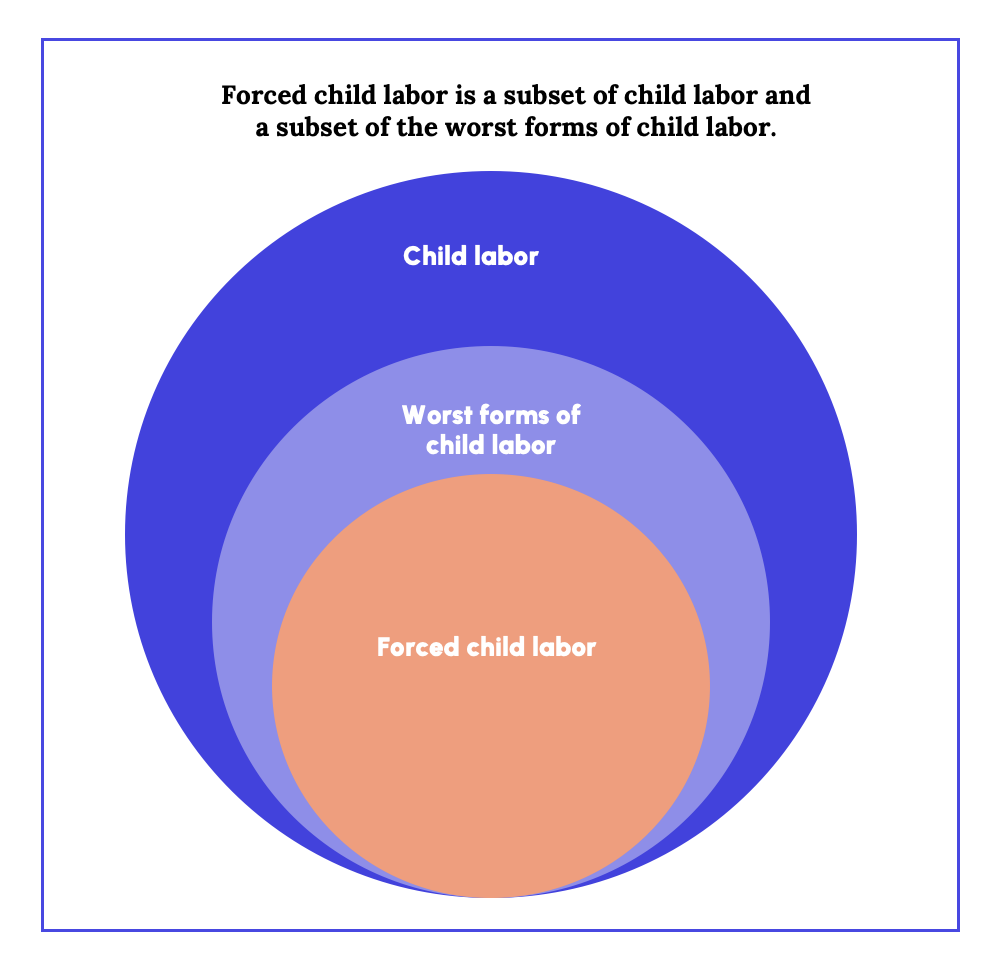
From a conceptual perspective, the relationship is straightforward: forced child labor is a subset of child labor, typically falling within its worst forms.
However, not all child labor is forced, as not all child labor involves coercion. While these distinctions appear clear in theory, companies rarely assess risks in such neatly defined categories.
In practice, identifying whether a situation constitutes child labor, forced child labor, or both often requires understanding the broader social and economic context in which children work.
Child labor v. forced child labor: A blurred line in practice
Child labor, and consequently forced child labor, are closely linked to structural drivers such as poverty, limited access to quality education and weak labor law enforcement.[9] UNICEF highlights that children often enter work because of economic hardship, for example following the sudden illness of a caregiver.[10]
In practice, distinguishing child labor from forced child labor depends on identifying coercion, which transforms exploitative work into forced labor. As stated above, forced child labor involves coercion exercised by a third party (other than the child’s parents).[11] This means that to find forced child labor, one must be able to determine whether a parent has decided that their child should work for family survival or whether a third party has coerced them into working is a significant operational challenge.
Children may also work because their parents are themselves in exploitative or coercive labor arrangements. Where a child works as a direct consequence of their parents being in forced labor, the child is automatically considered to be in forced labor themselves.[12] Identifying such situations in practice is equally challenging.
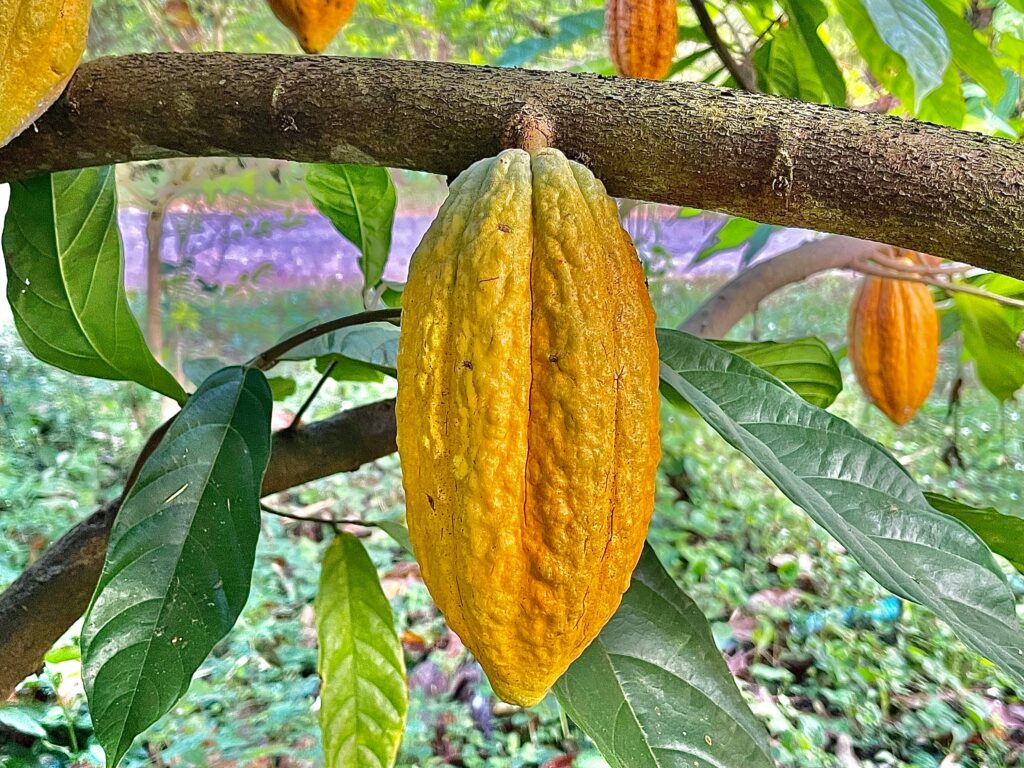
Example: The cocoa sectors in Côte d’Ivoire and Ghana illustrate the overlap between child labor and forced labor risks.
Child labor occurs in both countries[13], including children performing hazardous work such as using sharp tools, carrying heavy loads and being exposed to agrochemicals.
All this meets the definition of hazardous child labor, i.e., one of the worst forms of child labor.[14] And this may be driven by poverty or other root causes rather than coercion.
At the same time, reports have documented Ghanaian children and children from other West African countries trafficked into the cocoa sector[15], children in Cote d’Ivoire forced to work by actors other than their parents[16], and children who are themselves in forced labor because their parents are.[17]
As in these two contexts, child labor and forced child labor can coexist within the same communities, making operational distinctions difficult.
EUFLR: Why a holistic approach to risk assessment is needed
The EUFLR focuses on forced labor as it is one of the most serious and widespread human rights violations, affecting millions of people worldwide. An estimated 63% of forced labor cases occur in the private economy.[18] This is why businesses have a critical role to play in the elimination of forced labor, including forced child labor – one that the EUFLR aims to incentivize.
Identifying and addressing forced child labor, however, requires a holistic, risk-based and child-sensitive due diligence approach. Companies are more likely to identify forced child labor if they are already assessing child labor risks.
This is because both child labor and forced labor are driven by overlapping structural factor and the presence of child labor, particularly in hazardous or hidden contexts, may indicate vulnerabilities that increase the risk of forced child labor as well. Assessments conducted in isolation (i.e., assessing only forced child labor risks) may lead to overlooking warning signs embedded in broader child labor patterns and underestimating risks in highly vulnerable contexts.
A more effective approach therefore integrates both child labor risks and forced child labor risks into a single, child-sensitive risk assessment framework. By doing so, companies will be better equipped to identify vulnerabilities, prioritize engagement and strengthen their preparedness for the EUFLR.
Here is what the CORE team recommends businesses do:
- Include all forms of child labor in risk assessments: A broader assessment helps identify environments in which forced child labor may emerge.
- Use indicator-based methodologies to identify forced labor risks: While the presence of one or more indicators does not establish forced labor on its own, it may signal heightened risk requiring further assessment or supplier engagement.
- Incorporate contextual information into assessments: Understanding why children are working is often as important as observing that they are working, particularly where poverty, family labor or exploitative labor arrangements increase vulnerability to forced labor.
Recognizing the continuum between different forms of child labor provides a stronger basis for identifying, assessing and mitigating risks. As companies prepare for the application of the EUFLR, understanding the relationship between child labor and forced child labor will be essential for effective due diligence. If you would like to discuss what this means for your operations or supply chains, the CORE team would be happy to support you: hello@peopleatcore.com
Learn more about our EUFLR support here.
Cecilia and Lisa for the CORE team
[1] International Labour Organization (ILO) (2024) ‘Hard to see, harder to count: Handbook on forced labour surveys (3rd ed.)’ Page 5
[2] Ibid page 9
[4] International Labour Organization (ILO) (2012), ‘Hard to see, harder to count: Survey guidelines to estimate forced labour of adults and children’ pages 16-17.
[5] International Labour Organization (ILO) (2024) ‘Hard to see, harder to count: Handbook on forced labour surveys (3rd ed.)’ Page 3
[6] International Conference of Labour Statisticians (ICLS) (2018), ‘Guidelines concerning the measurement of forced labour’
[7] International Labour Organization (ILO) (2024) ‘Hard to see, harder to count: Handbook on forced labour surveys (3rd ed.)’ Page 3 See Art. 3 (a) of ILO Convention No. 182 on Worst forms of Child labour. Please note that other worst forms of child labour defined by ILO Convention No 182 such as the use, procuring or offering of a child for commercial sexual exploitation and illicit activities for the production and trafficking of drugs are not relevant in this context insofar as they are not linked to the manufacturing of products.
[8] International Labour Organization (ILO), What is child labour?
[9] ILO, What is child labour What are the main root causes of child labour?
[10] UNICEF, What is child labour? Why does child labour occur?
[11] See International Labour Organization (ILO) (2024) ‘Hard to see, harder to count: Handbook on forced labour surveys (3rd ed.)’ Page 3
[12] ICLS, ‘Guidelines Concerning the Measurement of Forced Labour’ (2018), para. 6 (iii).
[13] See also, American Institutes for Research (AIR), ‘Assessment Report: Efforts of Governments, Industry, and Workers’ Organizations to Address Child Labor and Forced Labor in the Cocoa Sectors in Ghana and Côte d’Ivoire’ (2024) prepared for the U.S. Department of Labor; page 21.
[14] See for instance, NORC at the University of Chicago, ‘Assessing Progress in Reducing Child Labor in Cocoa Production in Cocoa Growing Areas of Côte d’Ivoire and Ghana’ (2020), page 15; See also Lucy Pirkle et al., ‘Child Labour in Cocoa Growing Regions of Ghana and Côte d’Ivoire: An Analysis of Academic Attainment in Children Engaged in Hazardous Labour’, Global Public Health (2024), based on data from cocoa-growing regions in Ghana and Côte d’Ivoire.
[15] See, US Department of State, 2024 Trafficking in Persons Report: Ghana
[16] See, Global Slavery index/Spotlight, ‘Forced Labour: Chocolate’s Hidden Ingredient’ (2022); Verité, Cocoa ‘A study published by the Walk Free Foundation in 2018 found that approximately 14,000 children reported that they were forced to work by someone other than their parents […] in the cocoa sector in Ghana between 2013 and 2017. In Cote d’Ivoire, the same study found […] that approximately 2,000 children reported that they were forced to work by someone other than a parent”. See also, Walk Free Foundation (2018), ‘Bitter Sweets: Prevalence of Forced Labour and Child Labour in the Cocoa Sectors of Côte d’Ivoire and Ghana’ page 30.
[17] American Institutes for Research (AIR), ‘Assessment Report: Efforts of Governments, Industry, and Workers’ Organizations to Address Child Labor and Forced Labor in the Cocoa Sectors in Ghana and Côte d’Ivoire’ (2024) prepared for the U.S. Department of Labor; page 21.
[18] ILO, ‘Forced Labour, modern slavery and trafficking in persons’.